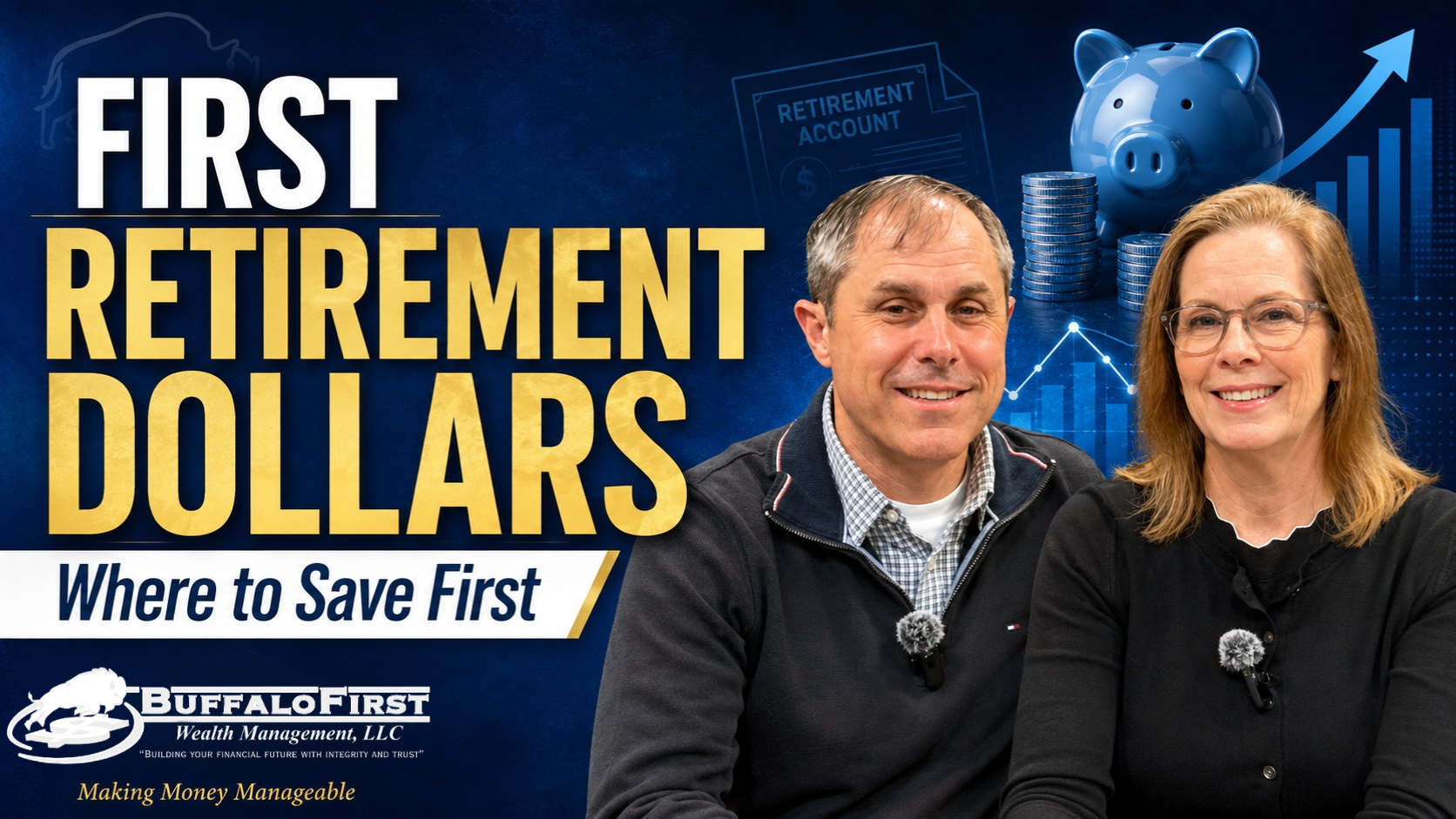
TL;DR: When Saving for Retirement, Prioritize Building an Emergency Fund First
Quick answer: Next, contribute enough to your employer’s 401(k) plan to capture the full employer match. After that, focus on paying down high-interest student loans and funding a Roth IRA to maximize tax-free growth over time.
Graduating and entering the workforce brings a lot of new responsibilities, especially when it comes to managing personal finances. A common challenge young professionals face is deciding exactly where to allocate their initial paychecks. With numerous account types and conflicting advice online, making the right choice can feel overwhelming.
Allen Dembski and Juliana Janson from Buffalo First Wealth Management regularly help young adults navigate this exact scenario. Their approach focuses on building a solid financial foundation before chasing complex investment strategies.
This guide breaks down the priority list for your early savings. You will learn how to balance student debt with wealth building, why capturing employer matches is crucial, and which retirement accounts offer the best tax advantages for early-career professionals.
Why should you build an emergency fund before investing?
Before opening a retirement account, you must build an emergency savings fund. Buffalo First Wealth Management identifies this as the number one recommendation for young professionals.
Financial emergencies happen unexpectedly. If your car breaks down or you face an unexpected medical bill, you need liquid cash. Without an emergency fund, you might be forced to withdraw money from a health savings account or a retirement portfolio. Because the stock market experiences regular volatility, pulling a thousand dollars from an investment account today means you might lock in a loss. An emergency savings account protects your long-term investments from short-term financial shocks.
How do student loans impact your retirement savings strategy?
Many graduates wonder if they should delay investing until they completely pay down their student loans. You need a clear understanding of your monthly cash flow to make this decision.
Even if you carry significant student loan debt, starting to invest in your 20s remains highly worthwhile. The decades of compound growth ahead of you will drastically multiply those early contributions. Establish your emergency cushion, budget for your required loan payments, and begin directing a portion of your remaining income toward retirement immediately.
Should you choose a traditional or a Roth retirement account?
Your current income level dictates which account type works best. Choose a Roth IRA or Roth 401(k) if you are young and earning a lower salary. Because your current tax rate is likely lower than it will be later in your career, paying taxes upfront makes the most mathematical sense. You secure 30 to 40 years of completely tax-free growth.
Choose a traditional, pre-tax account if you currently experience a heavy tax burden and need immediate tax relief. You can also open both account types and adjust your contribution strategy as your income fluctuates over the years.
Does an employer 401(k) match beat opening a separate IRA?
You should always maximize your employer match before putting money into a separate, individual account. Many companies offer to match a specific percentage of your salary, such as a 3% match when you contribute 3%. This is essentially free money. Even if your employer’s plan charges higher fees, the 100% immediate return of an employer match outweighs those costs.
Additionally, the SECURE Act 2.0 introduced a new benefit for young workers. Some Fortune 500 companies now direct their matching contributions toward an employee’s student loan payments. Look for this specific perk when evaluating job offers and benefits packages.
Is life insurance a good retirement investment for young adults?
Financial advisors frequently see young professionals purchasing life insurance products as retirement investments. However, life insurance does not serve as an effective retirement vehicle for 98% of the population.
Products like Infinite Banking typically offer a return rate of around 4%. Historically, the stock market has doubled that rate of return throughout a standard earning lifetime. Invest your money in the market instead. Those standard investment accounts can easily cover final expenses if an unexpected tragedy occurs.
Next steps for your financial journey
Technology makes it easier than ever to start saving, but generic internet advice cannot replace a personalized financial strategy. Start by auditing your current budget, setting aside cash for emergencies, and enrolling in your employer’s retirement plan. If you need help untangling your specific debt-to-income situation, reach out to a professional who can build a custom roadmap for your future.
Frequently asked questions
How much should I contribute to my employer 401(k)?
You should contribute at least enough to capture the full employer match. If your company matches up to 3% of your salary, contribute exactly 3% to avoid leaving free money on the table.
Are online AI tools reliable for personal finance advice?
Artificial intelligence tools and basic internet searches often lack the context of your complete financial picture. If you feed an AI tool incomplete information about your cash flow or debt, you will receive inaccurate advice. Consulting a human wealth manager ensures your unique situation is thoroughly evaluated.
Can I withdraw money from a Roth account in an emergency?
A Roth account offers more withdrawal flexibility than a traditional retirement account. You can generally withdraw your direct contributions (but not the earnings) without penalty, making it a safer option for young professionals who fear locking all their cash away.
Stay tuned for our next post.
Let’s Help You With Your Retirement Planning
Call us and let’s start helping you with your financial planning needs so you can make the most of your money.